I really don’t like ants. My argument is simple: if you see one, you know there are a thousand on their way ready to move in. I found one in my kitchen last week and, without hesitation, used my fat finger to crush it. Then I sprinkled ant powder in every corner and finally, I could sleep.
But a few days later, I found a spider in the bedroom. My other half reached for the slipper, and I called him a murderer and told him to stop as I sprinted for a glass and a piece of paper to escort it safely outside.
What’s The Difference?
I started to think about it. I’ll stand on an ant without guilt. If it were a mouse, I’d be finding ways to entice it outside. A rat? I’d call Rentokil. A dog? I’d make it a bed and welcome it to the family. Somewhere there’s an invisible moral line we all draw, but who decides where it sits?
An ant has around 250,000 neurons; a mouse about 70 million. An ant is basically a biological robot. A mouse can learn, remember, and even show a hint of empathy. A dog has roughly 530 million neurons and the emotional intelligence of a two-year-old child; it dreams, recognises faces, and feels joy, fear, and grief.
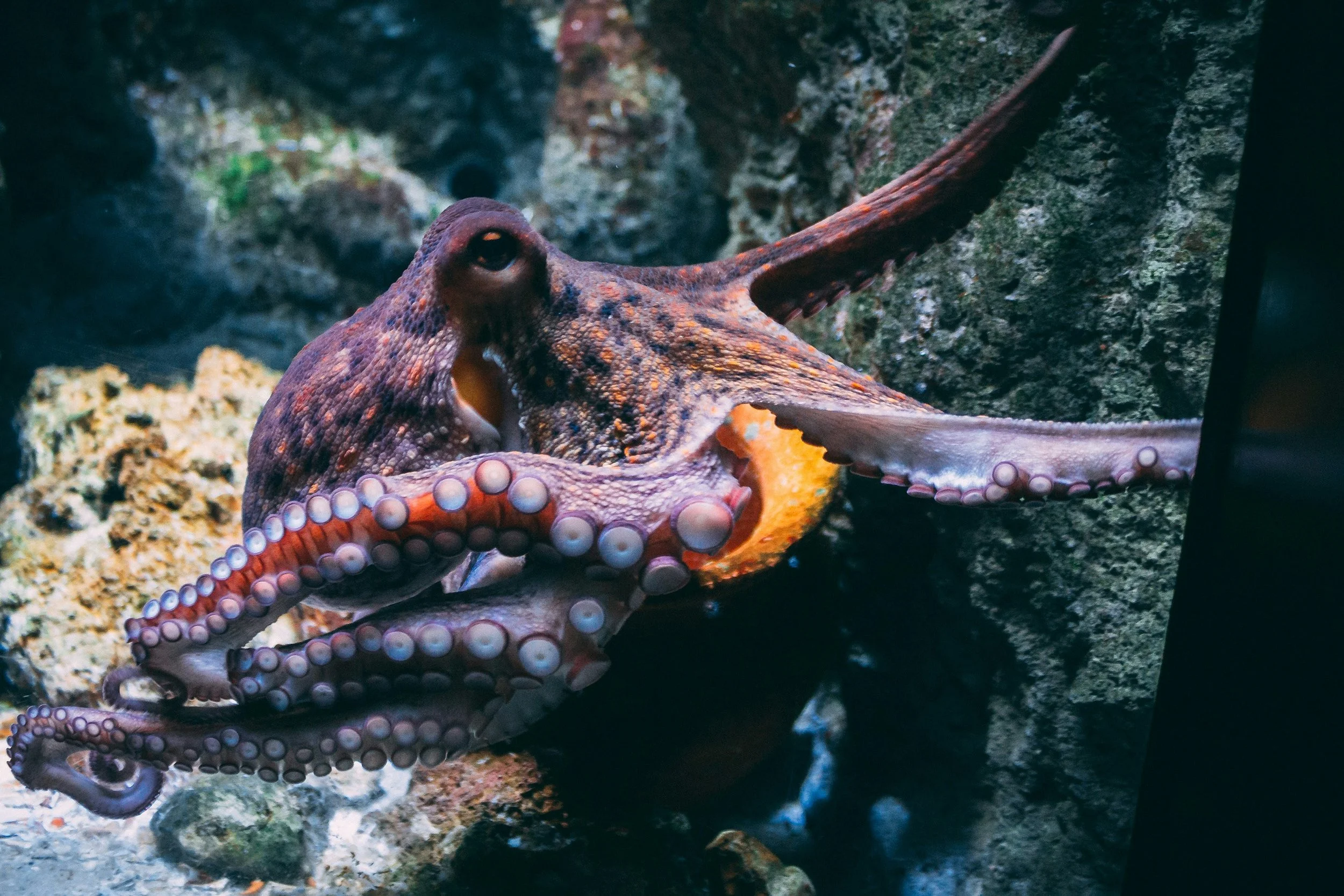
But if it’s purely about intelligence, why do we happily eat pigs? They’re as clever as toddlers, with around 425 million cortical neurons, sitting between cats and dogs on the brainpower scale. Or octopuses, those alien geniuses with about 500 million neurons, most of them in their arms. They can solve puzzles, use tools, escape from locked tanks, and even recognise individual humans, remembering who was kind and who wasn’t.
A quick side note about octopuses:
They have three hearts and blue blood. Two hearts pump blood to the gills and one pumps it around the body. The blood is blue because it’s copper-based, better suited to cold, low-oxygen water.
When they sleep, their skin flickers through colours and textures suggesting they may actually be dreaming. It’s one of the closest things we’ve seen to REM sleep in a non-mammal.
Their DNA is genuinely “alien-like” in a scientific sense. They have more genes than humans and can edit their own RNA in real time, allowing their neurons to reprogramme themselves without changing DNA. This kind of large-scale RNA editing is rare.
They taste through their suckers which are packed with chemoreceptors, so an octopus doesn’t just feel what it touches it tastes it instantly.
Their arms can make decisions independently of their brain. About two-thirds of their neurons live in the arms, meaning each limb can solve simple problems and choose movements on its own.
They are escape artists, known to unscrew lids from the inside, climb out of aquariums at night, and squeeze their entire body through holes the size of a coin. Inky the octopus famously slipped through a gap in his tank, slid across the aquarium floor and vanished down a drainpipe to the sea.
And yet… we still treat them like seafood rather than sentient escape artists.
It’s clearly not intelligence that earns our compassion. It’s familiarity. We care more about what looks or behaves like us, fur, eyes, expressions we can read. '
Neuroscientist Robert Sapolsky, author of Behave and Why Zebras Don’t Get Ulcers, explains that our brains are wired for tribal bias. The amygdala (the area that processes fear and threat) lights up differently depending on whether we see someone as “us” or “them.” It happens in milliseconds, before we’re even aware of it. In one study, people shown images of faces from their own group versus another had stronger amygdala activity toward the “outsiders.” The bias was unconscious, automatic, and purely biological, an ancient survival mechanism from when trusting the wrong tribe could get you killed.
The trouble is, in the modern world, those same circuits keep our compassion small and selective and we aren’t any more in a survival situation when it comes to ‘others’. It’s the same mental trick at work in how we judge people. When I was a kid, our British neighbours once reminded me that “they won the war.” I was the child of a German mother and an Italian father, apparently a foreign element lowering the tone of the street. Yet when I went to Italy or Germany, being British suddenly made me the exotic cool one. Years later, on that same street, a new Indian family moved in and a gay couple bought the corner house. The bias didn’t change, just the target. Who decides which difference is acceptable and which is a threat?
A Yoga Perspective
Most people think of yoga as stretching; touching your toes, breathing deeply, finding a bit of calm before the next bit of chaos. But underneath the shapes, it’s really a way of noticing. First we learn to notice our body, the pull of a hamstring, the wobble in balance, the breath we hold without realising. Then we start to notice the smaller, quieter reactions; frustration, comparison, pride, avoidance. The more we pay attention on the mat, the more we start seeing those same reflexes off the mat too.
That’s when yoga becomes a practice of awareness rather than flexibility. It doesn’t ask us to pretend we’re free of bias or judgement, it just gives us the tools to see them. The ancient texts call this Viveka, discernment, the ability to tell what’s real from what’s conditioned. We like to think our opinions are our own, but most are borrowed, shaped by family, culture, or fear. Yoga’s invitation is simple: to stay awake enough to question what feels automatic, whether that’s the urge to step on an ant or to decide who is bringing the neighbourhood down.
We don’t get to switch off bias. It’s baked into the wiring. But we do get to stay conscious of it. The gap between the instinct and the action is where your agency sits. That pause, that moment of “is this actually true?” is the whole practice.
In the end, the question of who gets to matter isn’t answered by intelligence, similarity or instinct. It’s answered by attention. Whatever we’re awake enough to notice, whether an ant, a neighbour, or our own knee-jerk reactions is what we start treating differently.
A 30-Second Viveka Practice
The next time something sparks that quick, automatic reaction: irritation, judgement, shrinking away, puffing up… pause for a single breath and ask: “Is this coming from fear, habit, or something real?”
You’re not trying to correct the reaction or become a better person. You’re just noticing the source. That sliver of clarity is the whole practice: awareness before assumption.
Photo by Diane Picchiottino on Unsplash
I originally shared a version of this in my weekly newsletter. If you’d like the next one delivered to you, you can sign up here.
