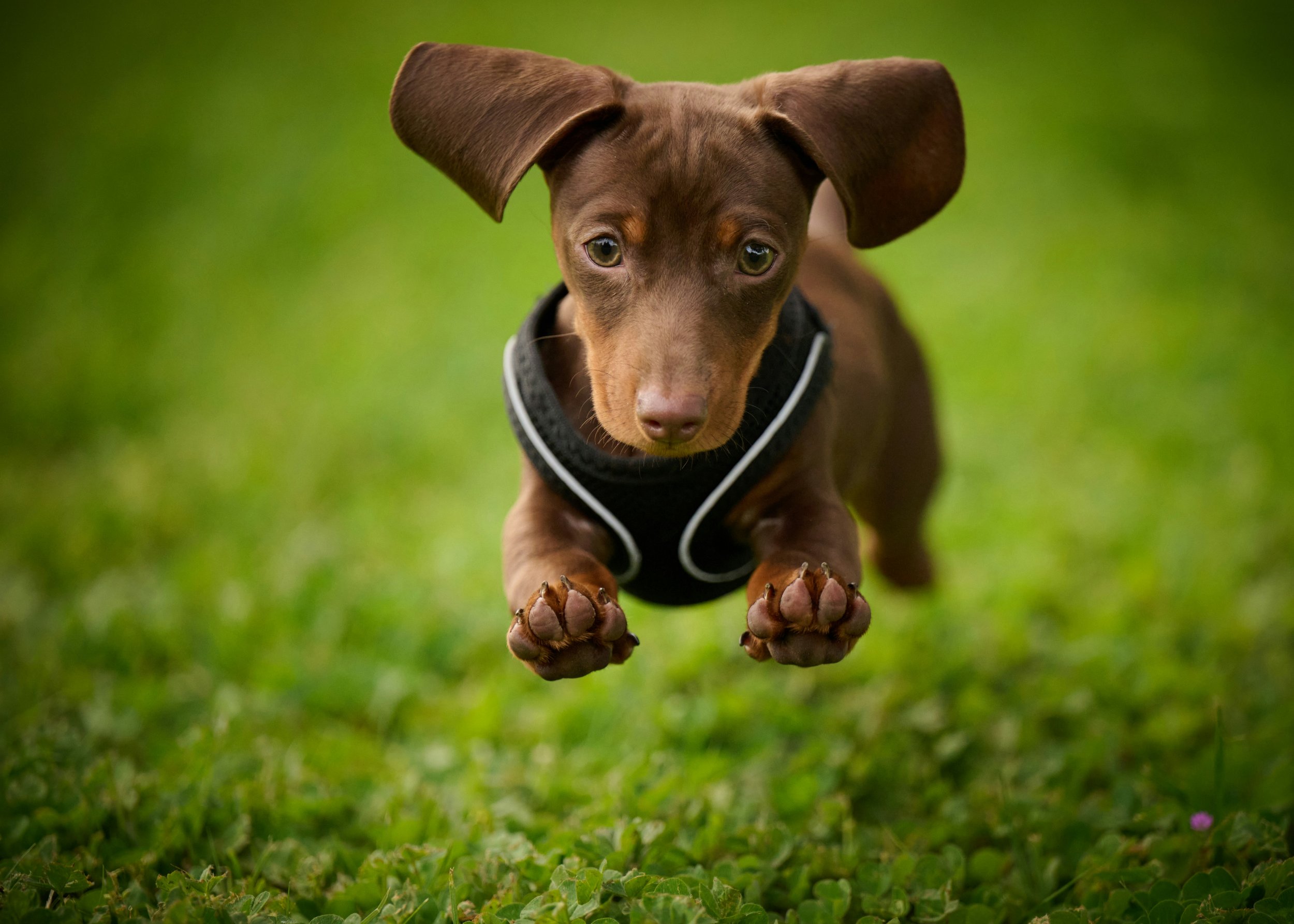
When I used to run - which, it turns out, was a long time ago - my dog came with me. It was the ultimate multitask: I got my exercise, and the dog got his. What bugged me, however, was that, while I was running at what felt like a fair pace, my dog was ambling, barely trotting. Even at my fastest, his bemused look seemed to say, “Is this it? Is this your best?” Then, he'd dart ahead, expecting me to keep up, but he was waaaay too fast.
I kept telling myself to stay focused - keep my own pace, breathe, just put one foot in front of the other. But inevitably, I sped up, trying to match a tempo that wasn’t mine. Soon enough, I’d look around, and everyone was ahead of me, even the Dachshunds with their tiny legs going nowhere. All the dogs in the park were laughing at me, while their owners either pulled out their phones to video my frazzled state or stood ready to call an ambulance for my inevitable collapse.
The truth was, I had let myself be influenced by everyone around me. I couldn’t breathe because I was trying to keep a pace that wasn’t mine. I was going nowhere, fast. Or, more accurately, slowly.
Keeping Up with the Pack
It got me thinking: We’re running at a pace we didn’t set, influenced by the world around us, and barely able to keep up.
In an excellent 2021 article, Michael Simmons explored futurist Ray Kurzweil’s prediction that the rate of technological change would double every decade. He put it like this: “Twenty years from now, the rate of change will be four times what it is now. Said differently, for someone who is 40 today, when they’re 60 in 2040, the rate of paradigm change will be four times what it is now. They will experience a year of change (by today’s standards) in three months. For someone who is 10 today, when they’re 60, they’ll experience a year of change in 11 days.”
Think about that for a moment. We’re not going to experience just 100 years of progress this century - we’ll see the equivalent of 20,000 years of change. It’s no wonder we feel frazzled.
As soon as I learn how to do something "modern" (yep, officially sounding middle-aged now), it’s outdated. I figured out how to record on a VCR, then had to learn how to take a photo on a phone, and now I'm editing videos with captions, music, and rolling credits while using AI to generate a media strategy to make it go viral - and I’m still waaaay behind. Whatever I’ve learned is already "so last year." Or last month. Or yesterday.
The problem is, our bodies and brains aren’t built for this. We evolved to move, to hunt, to solve problems on the go - not to spend hours sitting still, drowning in information. We’re designed to build communities, to communicate face-to-face, and to rest at night, aligned with natural rhythms. Instead, we’re glued to screens, with artificial light keeping us awake, overstimulated, and out of sync. Our circadian rhythms, the internal clocks that tell us when to sleep, wake, and rest, can get knocked off-kilter.
Finding Your Own Pace
And while we can’t stop this rapid pace of change, we can at least be aware of when it's pushing us too hard, making us run faster than is good for us. There's no way we can process a year’s worth of information in 11 days. So maybe the solution isn’t to keep up, but to tune inward and find what pace works for us.
If only there were something that could help us do this. Oh wait, there is - yoga.
Yoga teaches us to listen to our bodies and respond accordingly. I go into a class wanting to keep up with everyone else who’s doing the splits, but my body tells me, "Not yet. Just wait here in this half-splits position for a while." And instead of pushing myself into injury, I trust what my body is telling me. Over time, I go a little deeper. It’s a slow, gradual process - not a race. Notice I didn’t say, “I succeed in doing the perfect splits,” because that’s not the goal. The goal is listening, working with what your body needs, and not trying to keep up with the galloping pack of dogs.
Of course, you can improve and maybe one day reach the full splits pose. Working at your own pace, in tune with what your body needs, gives you room to progress without making someone else’s range your target.
Who’s Setting Your Tempo?
Where are you trying to keep pace with the pack - and where are you setting your own tempo? How does it feel to tune into your own rhythm instead of everyone else’s?
And, of course, do more yoga.
If you enjoyed this, I send a thoughtful, sometimes slightly cheeky weekly email. Sign up here.
Photo by Steve Smith on Unsplash
